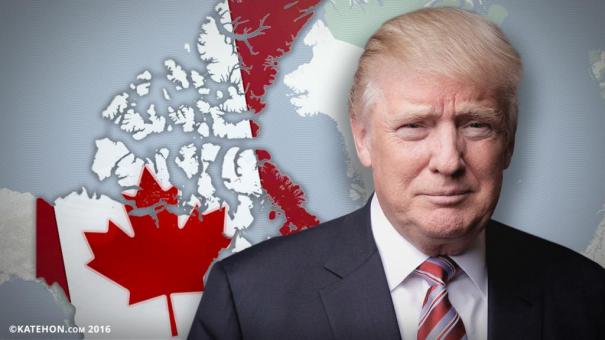
 The shock election of Donald Trump has thrust Canada into one of the most perilous periods of its existence. Our relationship with the United States, upon which so much of our security and prosperity depends, has never been more uncertain.
 Canada's staid liberal-conservative political map on most economic issues and even social issues has been relatively flat. Conservatives in Canada, like in the US, are what Trump supporters (really just Tea Party lite) call "cuckservatives" -- cuckolded by the liberals on both economic and social issues (free trade, global warming, feminism, abortion, affirmative action, gaylib).
Canada just emerged from a nasty Conservative decade last year, a mix of cuckservative on social issues (to steal Liberal votes) and Trump old-time conservative on environment and energy (to carry out Harper's real agenda). Canadians breathed a collective sigh of relief to be done with him.
So Canada is a bit of a foretaste of what is to come for the US. Harper was a Trumper on global warming and environmental policy, withdrawing from the Kyoto Protocol and showing little interest in the Paris negotiations. It was a shameful period, with environmental research gutted, scientists muzzled so as not to raise red flags, the environmentally destructive Alberta tarsands boondoggle, plans for pipelines to the west, east and south to the US.
It was a relief to get the 'real thing' again, the liberal agenda with all its failings, even if, so far, it is not doing much of anything good. On the Kinder-Morgan pipeline, Trudeau dawdled, hoping people would lose interest, and then approved, cynically relying on a Canada-wide opinion poll that said 51% Canadians approve and 64% figure it will go ahead no matter what. He twisted BC's Liberal premier to go along with him. Trudeau also vows that the tarsands will expand and produce tar for "decades ahead".
Liberals at least pretend to listen to protesters, and the ongoing pipeline protests since November 2016 across Canada and on Parliament Hill will remind the young, trendy PM of his constituents' demands. His famous populist 'selfies' are already causing him embarrassment.
Trump will not show any interest at all in such liberal complaints. Already, he has vowed to revive the Keystone XL pipeline project, blocked by President Obama under pressure from environmentalists. That would make it easier for Trudeau to pander to the oil industry, both in revving up the tarsands and green lighting their pipeline plans. Canada will face mass protests, energized by allies south of the border.
Despite his waffling on the oil issues, Trudeau put Canada back on the environmental road--at least in words--joining the Paris Accord, which his conservative predecessor refused to do, and reinstating environmental research programs which Harper had slashed with his second term majority.
The current situation recalls the relations that Justin's father Pierre and his successor Jean Chretien had with thorny American presidents of yesteryear, Johnson, Nixon and George Bush. Relations reached ever new low points over Vietnam and Iraq.
'It’s overrun by godless, gunless hippies'
Probably Trudeau will find Trump indifferent to Canadian demands, despite Canada being America's closest ally in every sense, and its largest trading partner. His knowledge of Canada is less than zero, despite adding his logo to Toronto's top hotel, Trump Towers, the second tallest skyscraper in Canada.
His efforts to expand in Canada were met with disdain for his Trump 'brand' during his gaffe-plagued presidential campaign. Disputes and a messy legal divorce ensued. Still unfinished in 2016, it is already in bankruptcy court. A bad omen for the Donald in Canada.
Perhaps that's what motivated his bizarre comments last July when he told "Fox and Friends" that he believes the US “should never have allowed” Canada to gain independence, that the United States owned Canada “at some point”, and giving it back was a “major mistake”. The former reality tv star was responding to a question about Puerto Rico possibly becoming the 51st of the United States, when he made the statement. “It used to be 51 you know, when we had Canada."
As a harbinger of what he has in store for Canada, he explained, "Look at that place now, it’s falling to pieces. It’s overrun by godless, gunless hippies." “Well what are you going to do if elected?” the interviewer Kilmeade asked. “Forcefully take Canada and claim it as part of America?”“I think that’s gotta be an option,” Trump responded. “You know, they’ve got a lot of oil up there, a lot."
What's on the real agenda?
After Keystone XL, there's the Trans-Pacific Partnership, which can’t go ahead without the US. No decision on pulling out of TPP becomes final until February 2018, so there is a breathing space. Perhaps the other 11 members, including Canada, will agree to renegotiate.
Then there's NAFTA, which is almost two decades old and has reshaped the North American and Mexican economies. “Canada is the chief export market of 35 US states, and 9 million US jobs depend directly on US exports to Canada, ” said Canada's International Trade Minister Chrystia Freeland. While Mexico and Canada increased their trade with the US under NAFTA, the US goods trade deficit with Canada and Mexico has grown from $9.1 billion in 1993 to $76.2 billion in 2015. NAFTA’s effect on US jobs is disputed, despite Freeland's soothing words.
But renegotiating this complex treaty would be very difficult;,no one-way street. Canada and Mexico are preparing their own list of demands that could require difficult US concessions. If Trump just tears it up, Mexico would suffer much more than Canada, as Canada and the US would automatically revert to the pre-existing free-trade agreement (FTA) between Canada and the United States.
Mexican President Enrique Pena Nieto said that he would be willing to discuss NAFTA with Trump to “modernize” the treaty, but not renegotiate existing provisions, which could include adding environmental, labor and other provisions that weren’t contemplated when NAFTA was being negotiated in the early 1990s. Trudeau said Canada will insist that any renegotiation bring an end to a decades-old dispute over Canadian exports of softwood lumber, said David MacNaughton, Canada’s ambassador to the United States.
Both Mexico and Canada would likely demand greater access to compete for US public sector procurements, now largely protected by “Buy America” laws. A major Trump administration infrastructure spending program would make this a more enticing target.
Canadian workers wil be glad to see the back of NAFTA, as they lost heavily to the US and Mexico. It is Mexico that faces serious problems if NAFTA is cancelled. In addition, there is the demand that it erect a wall and the prospect of millions of illegal workers in the US being deported, many to Mexico.
US-Canadian polar vortex?
If the United States is moving down an illiberal path, alongside Tea Party Republicans, relations with the United States could be more contentious than they have been in decades.
Is there anything Trump might learn from Canada (besides Canada's history)? Stepping up Canadian engagement in multilateralism--including a United Nations peacekeeping mission to Africa--can set an example for the world that even US president-elect Donald Trump might want to follow, says former Canadian governor general Michaelle Jean.
That's not likely, though no one knows what his foreign policies will be anywhere, so who knows?
Canada and the US are on different trajectories now. The big news as Trump plans to increase coal production is that Canada would speed up the transition from traditional coal power to clean energy by 2030.
Perhaps Trump will study his like-minded Tea Partiers Harper and Australian ex-PM Tony Abbott. Harper and Abbott were global warming deniers, bucking popular opinion, and are gone. Australia, now under a post-Abbott government, ratified the Paris Agreement hours after Trump's election. In a hopeful sign, Trump has already backed off his threats to quit the Paris Accord, and admitted that global warming is real after all.
Trump will face opposition domestically, some of it from his own industrialists, who embraced cleaner techology under Obama, with an eye on exporting. Local and regional governments have also been taking their own action on climate, as happened in Canadian provinces adopting carbon taxes and cap-and-trade systems despite Harper's stalling. Besides, costs of alternative energy are falling, and coal is not so cheap anymore.
The US will face pressure from other nations, too, including some that were once seen as climate laggards. China is urging America to stand by the Paris Agreement, adding that it plans to continue to combat climate change “whatever the circumstances.”
katehon.com